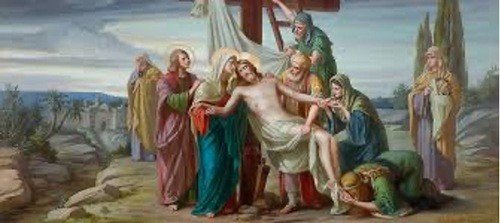
Station 13 — Jesus Is Taken Down from the Cross
Primary Scripture: John 19:38–40
“After these things, Joseph of Arimathea… asked Pilate to let him take away the body of Jesus. Pilate gave him permission; so he came and removed his body. Nicodemus… also came, bringing a mixture of myrrh and aloes… They took the body of Jesus and wrapped it with the spices in linen cloths, according to the burial custom of the Jews.”
(See also Luke 23:50–53.)
The Historical Moment
Death by crucifixion was public.
Burial was often denied.
Yet Jesus is not discarded.
Joseph of Arimathea — described as a respected member of the council, and one who was waiting for the kingdom of God — steps forward. He risks association with a condemned man. He goes directly to Pilate and asks for the body.
Nicodemus comes too — the same Nicodemus who once visited Jesus at night (John 3). Now he appears in daylight, carrying costly burial spices.
The nails are removed.
The body is lowered.
Bloodied wood releases its burden.
And for a moment, the One who hung between heaven and earth rests in human hands.
Christian tradition often lingers here with the image of Mary holding her son — an echo of Bethlehem, now reversed in sorrow. Scripture does not describe her actions, but John tells us she stood near the cross (John 19:25). It is not hard to imagine her close when His body was taken down.
The Theological Weight
Station 12 was completion.
Station 13 is tenderness.
The violence has ended.
The stillness begins.
Isaiah 53:9 foretold:
“They made his grave with the wicked and his tomb with the rich.”
Joseph’s unused tomb fulfills that strange pairing — executed among criminals, buried with honor.
The same hands that pierced Him now release Him.
The same world that rejected Him now receives His lifeless body.
There is no miracle here yet.
No triumph.
Only care.
What This Reveals
Love does not disappear when hope seems gone.
Joseph and Nicodemus act when the visible victory has not yet arrived. They do not know Sunday is coming.
They only know that this body matters.
Faith sometimes looks like reverence in the dark.
Preparing a body for burial was intimate work — washing, wrapping, anointing. They tend to wounds they did not inflict but cannot undo.
This station teaches us that honoring Christ is not only about celebrating resurrection. It is also about staying present in grief.
The Place Today
Inside the Church of the Holy Sepulchre, a large stone slab near the entrance is traditionally remembered as the Stone of Anointing — the place where Jesus’ body was prepared for burial.
Pilgrims kneel there. They touch the stone. Some press cloths against it. The atmosphere is hushed, heavy, reverent.
It is not loud like Easter.
It is quiet like loss.
Why We Pause Here
We pause because many of life’s holiest moments happen after the crisis, in the quiet tasks of care.
Sitting beside a hospital bed.
Planning a funeral.
Holding a hand with no words left.
Station 13 tells us:
God is not absent from these moments.
The body of Christ is still precious — even in death.
Where are you called to show quiet faithfulness?
Where is love asking you to remain, even when the outcome feels sealed?
Prayer
Lord Jesus, taken down from the cross,
You were cradled by those who loved You.
Teach us to be faithful in sorrow.
Teach us to honor You not only in victory,
but in silence and grief.
Stay with us in the long nights when hope feels buried.
Amen.
Primary Scripture: John 19:38–40
“After these things, Joseph of Arimathea… asked Pilate to let him take away the body of Jesus. Pilate gave him permission; so he came and removed his body. Nicodemus… also came, bringing a mixture of myrrh and aloes… They took the body of Jesus and wrapped it with the spices in linen cloths, according to the burial custom of the Jews.”
(See also Luke 23:50–53.)
The Historical Moment
Death by crucifixion was public.
Burial was often denied.
Yet Jesus is not discarded.
Joseph of Arimathea — described as a respected member of the council, and one who was waiting for the kingdom of God — steps forward. He risks association with a condemned man. He goes directly to Pilate and asks for the body.
Nicodemus comes too — the same Nicodemus who once visited Jesus at night (John 3). Now he appears in daylight, carrying costly burial spices.
The nails are removed.
The body is lowered.
Bloodied wood releases its burden.
And for a moment, the One who hung between heaven and earth rests in human hands.
Christian tradition often lingers here with the image of Mary holding her son — an echo of Bethlehem, now reversed in sorrow. Scripture does not describe her actions, but John tells us she stood near the cross (John 19:25). It is not hard to imagine her close when His body was taken down.
The Theological Weight
Station 12 was completion.
Station 13 is tenderness.
The violence has ended.
The stillness begins.
Isaiah 53:9 foretold:
“They made his grave with the wicked and his tomb with the rich.”
Joseph’s unused tomb fulfills that strange pairing — executed among criminals, buried with honor.
The same hands that pierced Him now release Him.
The same world that rejected Him now receives His lifeless body.
There is no miracle here yet.
No triumph.
Only care.
What This Reveals
Love does not disappear when hope seems gone.
Joseph and Nicodemus act when the visible victory has not yet arrived. They do not know Sunday is coming.
They only know that this body matters.
Faith sometimes looks like reverence in the dark.
Preparing a body for burial was intimate work — washing, wrapping, anointing. They tend to wounds they did not inflict but cannot undo.
This station teaches us that honoring Christ is not only about celebrating resurrection. It is also about staying present in grief.
The Place Today
Inside the Church of the Holy Sepulchre, a large stone slab near the entrance is traditionally remembered as the Stone of Anointing — the place where Jesus’ body was prepared for burial.
Pilgrims kneel there. They touch the stone. Some press cloths against it. The atmosphere is hushed, heavy, reverent.
It is not loud like Easter.
It is quiet like loss.
Why We Pause Here
We pause because many of life’s holiest moments happen after the crisis, in the quiet tasks of care.
Sitting beside a hospital bed.
Planning a funeral.
Holding a hand with no words left.
Station 13 tells us:
God is not absent from these moments.
The body of Christ is still precious — even in death.
Where are you called to show quiet faithfulness?
Where is love asking you to remain, even when the outcome feels sealed?
Prayer
Lord Jesus, taken down from the cross,
You were cradled by those who loved You.
Teach us to be faithful in sorrow.
Teach us to honor You not only in victory,
but in silence and grief.
Stay with us in the long nights when hope feels buried.
Amen.
No Comments