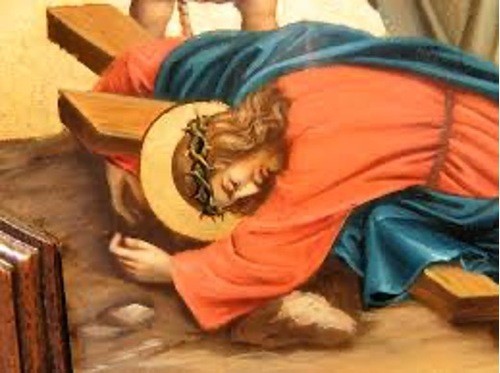
Station 9 — Jesus Falls a Third Time
Primary Scripture: Lamentations 3:1–2, 19–20
“I am one who has seen affliction…
he has driven and brought me into darkness without any light…
The thought of my affliction and my homelessness is wormwood and gall!
My soul continually thinks of it and is bowed down within me.”
(The Gospels do not record a third fall explicitly, yet they make clear the relentless suffering Jesus endured — Matthew 27:26–31; Mark 15:15–20.)
A Word About This Station
Tradition speaks of three falls. Scripture does not count them.
But Scripture does testify to exhaustion, humiliation, blood loss, and the long, grinding ascent toward crucifixion. By the time Jesus nears Golgotha, the hill is close — and so is the end.
The Via Dolorosa marks this third fall near the crest of the traditional path. Pilgrims often notice how tight and steep the streets feel there. The journey has been short in distance, but immense in cost.
The third fall represents the breaking point.
The Historical Reality
Crucifixion was engineered suffering.
By now Jesus’ body would have been in profound distress:
Collapsing again would not signal weakness of will. It would be the natural result of cumulative trauma.
The human body has limits.
Jesus did not bypass them.
The Theological Weight
Lamentations speaks of a soul “bowed down within me.”
The third fall captures that sense — not only physical collapse, but the nearing of total depletion.
If the first fall shows shock,
and the second shows endurance strained,
the third shows surrender to the edge of human capacity.
Yet even here, the story does not end.
He rises again.
Not triumphantly.
Not dramatically.
But necessarily.
The cross still stands ahead.
Philippians tells us Christ “humbled himself and became obedient to the point of death — even death on a cross.” (Philippians 2:8)
“Obedient to the point of death.”
That point is now within sight.
What This Reveals
The third fall speaks to those moments when we believe we have nothing left to give.
When prayers feel thin.
When strength feels gone.
When hope feels fragile.
It reminds us that faithfulness is not measured by how forcefully we stand, but by whether we continue.
Jesus does not abandon the road when collapse comes again.
He rises because love requires completion.
Why We Pause Here
We pause because some of us are walking through seasons that feel like a third fall.
Not the first hardship.
Not the second setback.
But the one that whispers, “This is too much.”
This station does not promise immediate relief.
It offers something steadier:
Christ has walked to the very edge of human endurance.
And He did not turn back.
The hill is near.
The cross is waiting.
The work is almost finished.
Prayer
Lord Jesus, when we reach the edge of our strength,
remind us that You have stood there too.
When we feel bowed down within,
lift our eyes toward Your faithfulness.
Carry us through the final stretch when we cannot see beyond the next step.
Amen.
Primary Scripture: Lamentations 3:1–2, 19–20
“I am one who has seen affliction…
he has driven and brought me into darkness without any light…
The thought of my affliction and my homelessness is wormwood and gall!
My soul continually thinks of it and is bowed down within me.”
(The Gospels do not record a third fall explicitly, yet they make clear the relentless suffering Jesus endured — Matthew 27:26–31; Mark 15:15–20.)
A Word About This Station
Tradition speaks of three falls. Scripture does not count them.
But Scripture does testify to exhaustion, humiliation, blood loss, and the long, grinding ascent toward crucifixion. By the time Jesus nears Golgotha, the hill is close — and so is the end.
The Via Dolorosa marks this third fall near the crest of the traditional path. Pilgrims often notice how tight and steep the streets feel there. The journey has been short in distance, but immense in cost.
The third fall represents the breaking point.
The Historical Reality
Crucifixion was engineered suffering.
By now Jesus’ body would have been in profound distress:
- Severe blood loss
- Dehydration
- Muscle trauma
- Shock
- Extreme fatigue
Collapsing again would not signal weakness of will. It would be the natural result of cumulative trauma.
The human body has limits.
Jesus did not bypass them.
The Theological Weight
Lamentations speaks of a soul “bowed down within me.”
The third fall captures that sense — not only physical collapse, but the nearing of total depletion.
If the first fall shows shock,
and the second shows endurance strained,
the third shows surrender to the edge of human capacity.
Yet even here, the story does not end.
He rises again.
Not triumphantly.
Not dramatically.
But necessarily.
The cross still stands ahead.
Philippians tells us Christ “humbled himself and became obedient to the point of death — even death on a cross.” (Philippians 2:8)
“Obedient to the point of death.”
That point is now within sight.
What This Reveals
The third fall speaks to those moments when we believe we have nothing left to give.
When prayers feel thin.
When strength feels gone.
When hope feels fragile.
It reminds us that faithfulness is not measured by how forcefully we stand, but by whether we continue.
Jesus does not abandon the road when collapse comes again.
He rises because love requires completion.
Why We Pause Here
We pause because some of us are walking through seasons that feel like a third fall.
Not the first hardship.
Not the second setback.
But the one that whispers, “This is too much.”
This station does not promise immediate relief.
It offers something steadier:
Christ has walked to the very edge of human endurance.
And He did not turn back.
The hill is near.
The cross is waiting.
The work is almost finished.
Prayer
Lord Jesus, when we reach the edge of our strength,
remind us that You have stood there too.
When we feel bowed down within,
lift our eyes toward Your faithfulness.
Carry us through the final stretch when we cannot see beyond the next step.
Amen.
No Comments