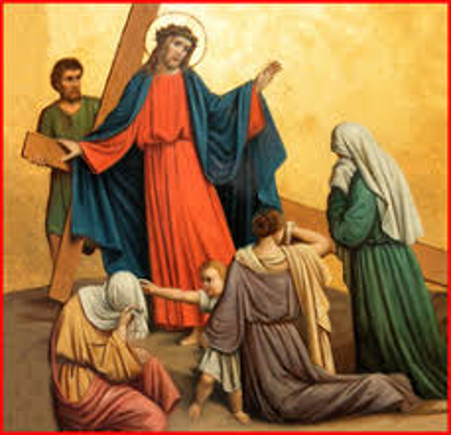
Station 8 — Jesus Speaks to the Women of Jerusalem
Primary Scripture: Luke 23:27–31
“A great number of the people followed him, and among them were women who were beating their breasts and wailing for him. But Jesus turned to them and said, ‘Daughters of Jerusalem, do not weep for me, but weep for yourselves and for your children…’”
The Historical Setting
Luke alone records this moment.
As Jesus is led toward Golgotha, the procession draws a crowd. Among them are women publicly mourning — beating their breasts, wailing in grief. Public lament was common in the ancient Near East. Executions were brutal spectacles, and expressions of sorrow were not hidden.
And yet, in the middle of His own suffering, Jesus stops.
He turns.
He speaks.
This is astonishing. He is bruised, bloodied, exhausted — and still attentive to others.
Along the Via Dolorosa today, the eighth station is marked by a simple stone cross carved into the wall. The inscription nearby recalls His words to the “Daughters of Jerusalem.”
The Theological Weight
“Do not weep for me.”
That is not what we expect.
We want Jesus to receive sympathy. We assume He would welcome comfort. Instead, He redirects their tears.
“Weep for yourselves and for your children.”
Jesus is not dismissing compassion. He is widening the lens.
He speaks of days coming when people will call the barren blessed. He references judgment and suffering yet ahead — language many scholars connect to the destruction of Jerusalem in A.D. 70, when Rome would devastate the city.
Even on the road to His own death, Jesus speaks prophetically.
He is not merely a victim of events.
He is Lord within them.
What This Reveals
If earlier stations show us physical collapse and human compassion,
this station reveals spiritual clarity.
Jesus is not consumed by self-pity.
He is still teaching.
He is still warning.
He is still inviting repentance.
The cross is not only about personal sorrow.
It is about the gravity of sin and the reality of judgment.
The women weep for what they see — a broken man walking toward execution.
Jesus calls them to weep for what they do not yet see — the consequences of rejecting God’s peace.
Earlier in Luke’s Gospel, Jesus wept over Jerusalem (Luke 19:41–44). Now He tells Jerusalem to weep for itself.
Why We Pause Here
We pause because it is possible to feel sympathy for Jesus without grasping why the cross was necessary.
It is easier to mourn suffering than to confront sin.
Jesus’ words remind us that Good Friday is not only about emotional response. It is about spiritual awakening.
Are we grieving the spectacle of the cross —
or are we allowing it to examine our own hearts?
“Do not weep for me.”
These words gently unsettle us.
They remind us that the cross is not simply tragedy.
It is revelation.
Revelation of injustice.
Revelation of mercy.
Revelation of what happens when humanity resists the way of peace.
Prayer
Lord Jesus, even in suffering You spoke truth.
Turn our attention where it needs to be turned.
Do not let us settle for shallow sorrow.
Lead us to repentance, to clarity, and to deeper faith.
Amen.
Primary Scripture: Luke 23:27–31
“A great number of the people followed him, and among them were women who were beating their breasts and wailing for him. But Jesus turned to them and said, ‘Daughters of Jerusalem, do not weep for me, but weep for yourselves and for your children…’”
The Historical Setting
Luke alone records this moment.
As Jesus is led toward Golgotha, the procession draws a crowd. Among them are women publicly mourning — beating their breasts, wailing in grief. Public lament was common in the ancient Near East. Executions were brutal spectacles, and expressions of sorrow were not hidden.
And yet, in the middle of His own suffering, Jesus stops.
He turns.
He speaks.
This is astonishing. He is bruised, bloodied, exhausted — and still attentive to others.
Along the Via Dolorosa today, the eighth station is marked by a simple stone cross carved into the wall. The inscription nearby recalls His words to the “Daughters of Jerusalem.”
The Theological Weight
“Do not weep for me.”
That is not what we expect.
We want Jesus to receive sympathy. We assume He would welcome comfort. Instead, He redirects their tears.
“Weep for yourselves and for your children.”
Jesus is not dismissing compassion. He is widening the lens.
He speaks of days coming when people will call the barren blessed. He references judgment and suffering yet ahead — language many scholars connect to the destruction of Jerusalem in A.D. 70, when Rome would devastate the city.
Even on the road to His own death, Jesus speaks prophetically.
He is not merely a victim of events.
He is Lord within them.
What This Reveals
If earlier stations show us physical collapse and human compassion,
this station reveals spiritual clarity.
Jesus is not consumed by self-pity.
He is still teaching.
He is still warning.
He is still inviting repentance.
The cross is not only about personal sorrow.
It is about the gravity of sin and the reality of judgment.
The women weep for what they see — a broken man walking toward execution.
Jesus calls them to weep for what they do not yet see — the consequences of rejecting God’s peace.
Earlier in Luke’s Gospel, Jesus wept over Jerusalem (Luke 19:41–44). Now He tells Jerusalem to weep for itself.
Why We Pause Here
We pause because it is possible to feel sympathy for Jesus without grasping why the cross was necessary.
It is easier to mourn suffering than to confront sin.
Jesus’ words remind us that Good Friday is not only about emotional response. It is about spiritual awakening.
Are we grieving the spectacle of the cross —
or are we allowing it to examine our own hearts?
“Do not weep for me.”
These words gently unsettle us.
They remind us that the cross is not simply tragedy.
It is revelation.
Revelation of injustice.
Revelation of mercy.
Revelation of what happens when humanity resists the way of peace.
Prayer
Lord Jesus, even in suffering You spoke truth.
Turn our attention where it needs to be turned.
Do not let us settle for shallow sorrow.
Lead us to repentance, to clarity, and to deeper faith.
Amen.
No Comments