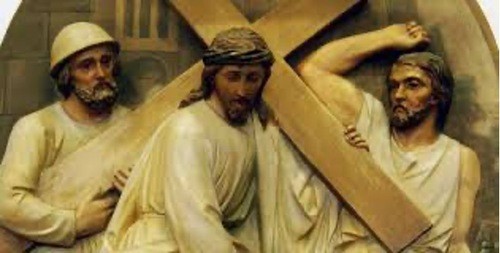
Station 5 — Simon of Cyrene Helps Carry the Cross
Primary Scripture: Luke 23:26
“As they led him away, they seized a man, Simon of Cyrene, who was coming from the country, and they laid the cross on him, and made him carry it behind Jesus.”
Prophetic Echo: Isaiah 53:4
“Surely he has borne our infirmities and carried our diseases…”
The Historical Setting
By this point, Jesus had been scourged, mocked, and forced to carry the crossbeam through the crowded streets of Jerusalem. The incline toward Golgotha was not long by modern measurement, but under such strain it would have felt endless.
Roman soldiers were practical. If a condemned man collapsed and could not continue, the procession stalled. And Rome did not stall.
So they seized a bystander.
Simon was from Cyrene — a city in North Africa (modern-day Libya). He was likely in Jerusalem for Passover. Mark’s Gospel even tells us he was “the father of Alexander and Rufus” (Mark 15:21), suggesting his family later became known in the early Christian community.
Simon did not volunteer.
He was compelled.
Along the Via Dolorosa today, pilgrims pause at the traditional fifth station near a small Franciscan chapel. The streets narrow there. Shops press close. The climb is noticeable. One can feel how the burden would have grown heavier with every step.
And in that place of strain, the weight shifted — if only partially — to another set of shoulders.
The Theological Weight
Luke’s wording is striking:
“They laid the cross on him, and made him carry it behind Jesus.”
Behind Jesus.
Earlier in Luke’s Gospel, Jesus had said:
“If any want to become my followers, let them deny themselves and take up their cross daily and follow me.” (Luke 9:23)
Simon becomes the first literal fulfillment of that command.
He carries a cross.
He walks behind Jesus.
He participates — unwillingly at first — in the suffering of Christ.
There is mystery here.
The cross that ultimately belongs to Jesus alone — the burden of sin — cannot be shared. Yet the physical weight, the visible shame, the public humiliation — these are momentarily placed upon another.
It is a small picture of discipleship.
To follow Christ is not abstract belief.
It is costly proximity.
What This Reveals
Until this point, Jesus has borne the weight alone.
Now someone else steps into the story.
Not a disciple from Galilee.
Not one of the Twelve.
But a man pulled from the margins.
God’s redemptive story often widens in unexpected ways.
Simon may have arrived in Jerusalem as a pilgrim. He left having walked the road to Calvary behind the Son of God.
Sometimes the crosses we carry are not chosen.
They are placed upon us.
And yet, in carrying them, we find ourselves nearer to Christ than we imagined.
Why We Pause Here
We pause at this station because it confronts us with the cost of following.
Simon did not plan this interruption. His day was rearranged. His shoulders bruised. His reputation perhaps questioned.
But in the kingdom of God, interruptions often become invitations.
Where has life compelled you into burdens you did not seek?
Where has inconvenience become calling?
We do not romanticize suffering. But we do recognize that sometimes the path of discipleship is walked simply by taking the next step behind Jesus — even when the cross was not ours to begin with.
Prayer
Lord Jesus, You know the weight of the cross.
Teach us to walk behind You with courage.
When we are called to carry burdens we did not choose,
help us see them not only as hardship, but as holy ground.
Amen.
Primary Scripture: Luke 23:26
“As they led him away, they seized a man, Simon of Cyrene, who was coming from the country, and they laid the cross on him, and made him carry it behind Jesus.”
Prophetic Echo: Isaiah 53:4
“Surely he has borne our infirmities and carried our diseases…”
The Historical Setting
By this point, Jesus had been scourged, mocked, and forced to carry the crossbeam through the crowded streets of Jerusalem. The incline toward Golgotha was not long by modern measurement, but under such strain it would have felt endless.
Roman soldiers were practical. If a condemned man collapsed and could not continue, the procession stalled. And Rome did not stall.
So they seized a bystander.
Simon was from Cyrene — a city in North Africa (modern-day Libya). He was likely in Jerusalem for Passover. Mark’s Gospel even tells us he was “the father of Alexander and Rufus” (Mark 15:21), suggesting his family later became known in the early Christian community.
Simon did not volunteer.
He was compelled.
Along the Via Dolorosa today, pilgrims pause at the traditional fifth station near a small Franciscan chapel. The streets narrow there. Shops press close. The climb is noticeable. One can feel how the burden would have grown heavier with every step.
And in that place of strain, the weight shifted — if only partially — to another set of shoulders.
The Theological Weight
Luke’s wording is striking:
“They laid the cross on him, and made him carry it behind Jesus.”
Behind Jesus.
Earlier in Luke’s Gospel, Jesus had said:
“If any want to become my followers, let them deny themselves and take up their cross daily and follow me.” (Luke 9:23)
Simon becomes the first literal fulfillment of that command.
He carries a cross.
He walks behind Jesus.
He participates — unwillingly at first — in the suffering of Christ.
There is mystery here.
The cross that ultimately belongs to Jesus alone — the burden of sin — cannot be shared. Yet the physical weight, the visible shame, the public humiliation — these are momentarily placed upon another.
It is a small picture of discipleship.
To follow Christ is not abstract belief.
It is costly proximity.
What This Reveals
Until this point, Jesus has borne the weight alone.
Now someone else steps into the story.
Not a disciple from Galilee.
Not one of the Twelve.
But a man pulled from the margins.
God’s redemptive story often widens in unexpected ways.
Simon may have arrived in Jerusalem as a pilgrim. He left having walked the road to Calvary behind the Son of God.
Sometimes the crosses we carry are not chosen.
They are placed upon us.
And yet, in carrying them, we find ourselves nearer to Christ than we imagined.
Why We Pause Here
We pause at this station because it confronts us with the cost of following.
Simon did not plan this interruption. His day was rearranged. His shoulders bruised. His reputation perhaps questioned.
But in the kingdom of God, interruptions often become invitations.
Where has life compelled you into burdens you did not seek?
Where has inconvenience become calling?
We do not romanticize suffering. But we do recognize that sometimes the path of discipleship is walked simply by taking the next step behind Jesus — even when the cross was not ours to begin with.
Prayer
Lord Jesus, You know the weight of the cross.
Teach us to walk behind You with courage.
When we are called to carry burdens we did not choose,
help us see them not only as hardship, but as holy ground.
Amen.
No Comments