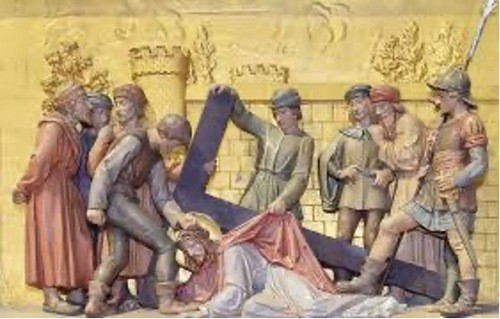
Station 3 — Jesus Falls Under the Weight of the Cross
Primary Scripture: Isaiah 53:6
“All we like sheep have gone astray; we have all turned to our own way, and the Lord has laid on him the iniquity of us all.”
(While the Gospels do not record a specific fall under the cross, they do tell us that Jesus was severely flogged before carrying it — Matthew 27:26; Mark 15:15 — leaving Him physically weakened.)
A Word About This Station
The Gospels do not describe Jesus falling beneath the cross. Yet Christians across centuries have reflected on this moment as a way of contemplating the physical reality of what He endured.
Roman scourging alone could leave a man barely able to stand. The crossbeam He carried likely weighed between 75 and 100 pounds. Add blood loss, shock, exhaustion, and public humiliation — and it requires no stretch of imagination to understand why the Church has long pictured Him stumbling beneath the load.
Along the Via Dolorosa in Jerusalem today, a small chapel marks the traditional site of the first fall. Pilgrims pause there in silence. Whether the exact location can be verified is secondary. What matters is what the moment represents.
The Historical Reality
Crucifixion was not designed to be efficient.
It was designed to be crushing.
Before a man was nailed to wood, he was stripped, scourged, mocked, and forced to carry his execution device through crowded streets. Weakness was not failure — it was part of the spectacle.
Jesus, fully divine, was also fully human.
His muscles trembled.
His lungs strained.
His body faltered.
The eternal Word who spoke galaxies into being now struggled beneath splintered timber.
The Theological Weight
If Station 1 showed us rejection,
and Station 2 showed us obedience,
this station shows us frailty.
Not sin.
Not defeat.
But human limitation.
Hebrews tells us we have a High Priest who is able to sympathize with our weakness (Hebrews 4:15). That sympathy is not theoretical. It is embodied.
When Isaiah says, “the Lord has laid on him the iniquity of us all,” we begin to understand the deeper weight pressing Him toward the ground. The burden was not wood alone. It was the accumulated rebellion of humanity.
Our wandering.
Our pride.
Our violence.
Our indifference.
The fall reminds us that sin crushes. And Christ stepped beneath it.
Where Pilgrims Pause Today
On the Via Dolorosa, Station III is marked by a small Armenian Catholic chapel. The stone streets slope upward. Even today, walking that incline under the Middle Eastern sun gives a sense of exertion.
It is not difficult to imagine knees hitting stone.
But this is not about reenacting a stumble.
It is about recognizing the cost of endurance.
Why We Pause Here
We pause because we are uncomfortable with weakness.
We prefer a triumphant Savior — strong, composed, untouchable.
But the Gospel gives us a Savior who entered exhaustion.
There are seasons when obedience feels like collapse. When faith feels less like soaring and more like surviving. When the weight of responsibility, grief, or guilt presses us toward the ground.
This station reminds us:
Falling is not the end of the story.
Christ does not remain on the pavement.
He rises.
Not because it is easy.
But because love compels Him forward.
Where in your life do you feel the weight pressing hardest?
Where do you need to remember that Christ understands human frailty from the inside?
Prayer
Lord Jesus, You know what it is to stagger beneath a burden.
You know the strain of obedience in a broken world.
When we feel crushed by weight we cannot carry alone,
remind us that You have carried far more.
Lift us when we fall, and steady our steps as we follow.
Amen.
Primary Scripture: Isaiah 53:6
“All we like sheep have gone astray; we have all turned to our own way, and the Lord has laid on him the iniquity of us all.”
(While the Gospels do not record a specific fall under the cross, they do tell us that Jesus was severely flogged before carrying it — Matthew 27:26; Mark 15:15 — leaving Him physically weakened.)
A Word About This Station
The Gospels do not describe Jesus falling beneath the cross. Yet Christians across centuries have reflected on this moment as a way of contemplating the physical reality of what He endured.
Roman scourging alone could leave a man barely able to stand. The crossbeam He carried likely weighed between 75 and 100 pounds. Add blood loss, shock, exhaustion, and public humiliation — and it requires no stretch of imagination to understand why the Church has long pictured Him stumbling beneath the load.
Along the Via Dolorosa in Jerusalem today, a small chapel marks the traditional site of the first fall. Pilgrims pause there in silence. Whether the exact location can be verified is secondary. What matters is what the moment represents.
The Historical Reality
Crucifixion was not designed to be efficient.
It was designed to be crushing.
Before a man was nailed to wood, he was stripped, scourged, mocked, and forced to carry his execution device through crowded streets. Weakness was not failure — it was part of the spectacle.
Jesus, fully divine, was also fully human.
His muscles trembled.
His lungs strained.
His body faltered.
The eternal Word who spoke galaxies into being now struggled beneath splintered timber.
The Theological Weight
If Station 1 showed us rejection,
and Station 2 showed us obedience,
this station shows us frailty.
Not sin.
Not defeat.
But human limitation.
Hebrews tells us we have a High Priest who is able to sympathize with our weakness (Hebrews 4:15). That sympathy is not theoretical. It is embodied.
When Isaiah says, “the Lord has laid on him the iniquity of us all,” we begin to understand the deeper weight pressing Him toward the ground. The burden was not wood alone. It was the accumulated rebellion of humanity.
Our wandering.
Our pride.
Our violence.
Our indifference.
The fall reminds us that sin crushes. And Christ stepped beneath it.
Where Pilgrims Pause Today
On the Via Dolorosa, Station III is marked by a small Armenian Catholic chapel. The stone streets slope upward. Even today, walking that incline under the Middle Eastern sun gives a sense of exertion.
It is not difficult to imagine knees hitting stone.
But this is not about reenacting a stumble.
It is about recognizing the cost of endurance.
Why We Pause Here
We pause because we are uncomfortable with weakness.
We prefer a triumphant Savior — strong, composed, untouchable.
But the Gospel gives us a Savior who entered exhaustion.
There are seasons when obedience feels like collapse. When faith feels less like soaring and more like surviving. When the weight of responsibility, grief, or guilt presses us toward the ground.
This station reminds us:
Falling is not the end of the story.
Christ does not remain on the pavement.
He rises.
Not because it is easy.
But because love compels Him forward.
Where in your life do you feel the weight pressing hardest?
Where do you need to remember that Christ understands human frailty from the inside?
Prayer
Lord Jesus, You know what it is to stagger beneath a burden.
You know the strain of obedience in a broken world.
When we feel crushed by weight we cannot carry alone,
remind us that You have carried far more.
Lift us when we fall, and steady our steps as we follow.
Amen.
No Comments