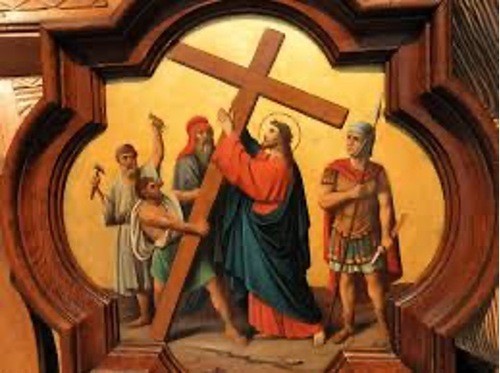
Station 2 — Jesus Takes Up His Cross
Scripture: John 19:16–17
“So they took Jesus; and carrying the cross by himself, he went out to what is called The Place of the Skull, which in Hebrew is called Golgotha.”
The Prophetic Echo
Isaiah had written:
“Surely he has borne our infirmities and carried our diseases…” (Isaiah 53:4)
The prophet spoke of a Servant who would carry what was not His own. John tells us that after the sentence was handed down, Jesus began to do exactly that — He carried the instrument of His execution.
The Historical Setting
Under Roman law, a condemned man was required to carry the horizontal beam of his cross — the patibulum — through public streets to the place of crucifixion. It was not merely transportation. It was humiliation.
Jerusalem during Passover was crowded. Pilgrims from across the region filled the narrow streets. The air would have been thick with dust, heat, and noise. Somewhere within that press of humanity, a bruised and bloodied Jesus lifted the wood onto torn shoulders.
John’s Gospel is striking in its clarity: “carrying the cross by himself.” At this moment, there is no mention of assistance. The burden is His.
Today, along the Via Dolorosa in Jerusalem’s Old City, pilgrims begin the traditional path at a site remembered as the place where Jesus took up the cross. Whether or not the stones beneath one’s feet are the exact stones He walked, the geography still presses in: tight streets, rising elevation, the weight of the climb.
But the true weight was not wood alone.
The Theological Weight
The cross was Rome’s symbol of shame and terror. It was designed to break bodies and send a message: This is what happens when you defy empire.
Yet Jesus does not resist. He does not flee. He does not call down angels.
Earlier in His ministry, He had said:
“If any want to become my followers, let them deny themselves and take up their cross daily and follow me.” (Luke 9:23)
Now He does what He once commanded.
The One who told others to take up a cross now shoulders His own.
This is not accidental suffering.
This is chosen obedience.
He carries the weight of sin, injustice, betrayal, and fear — not because He must, but because He loves.
Why We Pause Here
We stop at this station because it confronts us with a difficult truth:
Salvation was not abstract.
It was heavy.
Before the nails, before the final breath, there was the long walk. The slow steps. The grinding weight.
We often rush to the crucifixion itself. But the road matters. The carrying matters.
What burdens are you carrying right now?
Some are consequences. Some are callings. Some are crosses you did not choose but must bear.
When we pause here, we remember that Christ is not distant from the weight of human suffering. He has felt the strain in His own body.
And more than that — He walks ahead of us.
Prayer
Lord Jesus, You did not turn away from the weight placed upon You.
You carried the cross with steady resolve.
When our obedience feels heavy, strengthen us.
When our path feels long, walk before us.
Teach us what it means to follow You — even when the road rises.
Amen.
Scripture: John 19:16–17
“So they took Jesus; and carrying the cross by himself, he went out to what is called The Place of the Skull, which in Hebrew is called Golgotha.”
The Prophetic Echo
Isaiah had written:
“Surely he has borne our infirmities and carried our diseases…” (Isaiah 53:4)
The prophet spoke of a Servant who would carry what was not His own. John tells us that after the sentence was handed down, Jesus began to do exactly that — He carried the instrument of His execution.
The Historical Setting
Under Roman law, a condemned man was required to carry the horizontal beam of his cross — the patibulum — through public streets to the place of crucifixion. It was not merely transportation. It was humiliation.
Jerusalem during Passover was crowded. Pilgrims from across the region filled the narrow streets. The air would have been thick with dust, heat, and noise. Somewhere within that press of humanity, a bruised and bloodied Jesus lifted the wood onto torn shoulders.
John’s Gospel is striking in its clarity: “carrying the cross by himself.” At this moment, there is no mention of assistance. The burden is His.
Today, along the Via Dolorosa in Jerusalem’s Old City, pilgrims begin the traditional path at a site remembered as the place where Jesus took up the cross. Whether or not the stones beneath one’s feet are the exact stones He walked, the geography still presses in: tight streets, rising elevation, the weight of the climb.
But the true weight was not wood alone.
The Theological Weight
The cross was Rome’s symbol of shame and terror. It was designed to break bodies and send a message: This is what happens when you defy empire.
Yet Jesus does not resist. He does not flee. He does not call down angels.
Earlier in His ministry, He had said:
“If any want to become my followers, let them deny themselves and take up their cross daily and follow me.” (Luke 9:23)
Now He does what He once commanded.
The One who told others to take up a cross now shoulders His own.
This is not accidental suffering.
This is chosen obedience.
He carries the weight of sin, injustice, betrayal, and fear — not because He must, but because He loves.
Why We Pause Here
We stop at this station because it confronts us with a difficult truth:
Salvation was not abstract.
It was heavy.
Before the nails, before the final breath, there was the long walk. The slow steps. The grinding weight.
We often rush to the crucifixion itself. But the road matters. The carrying matters.
What burdens are you carrying right now?
Some are consequences. Some are callings. Some are crosses you did not choose but must bear.
When we pause here, we remember that Christ is not distant from the weight of human suffering. He has felt the strain in His own body.
And more than that — He walks ahead of us.
Prayer
Lord Jesus, You did not turn away from the weight placed upon You.
You carried the cross with steady resolve.
When our obedience feels heavy, strengthen us.
When our path feels long, walk before us.
Teach us what it means to follow You — even when the road rises.
Amen.
No Comments